2020-1: Ethel Is Not My Favorite Osprey
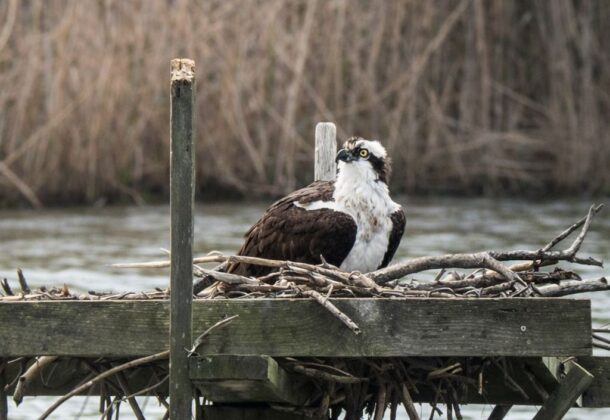
In March 2020, four Ospreys returned to established nests in Island Creek a couple hundred feet from our house and six Ospreys migrated north for the first time to skirmish over two new nest platforms the Captain had installed off the oyster house next door. A telescope in 2021 led to anthropomorphism, specifically, snarky names to the 10 Ospreys. In ’22 and ’23, the amount of Osprey poop had become an island issue. By ’24, that wasn’t an issue anymore.
This is season seven since my Osprey snooping began. My tattling on them begins here.
Ethel is not my favorite of the 10 Ospreys I’ve named but she has the best stories. And, also, she’s the only one who returned this spring.
She first arrived in 2020 with a gang of five other first-returners, invincible 2- and 3-year-olds, wildly alive, convinced they’d nailed their natal territory and raring to stake a claim.
The other four Ospreys, two long-time pairs, returned as usual to the two nests atop pilings in Island Creek about 100 feet offshore from the island house. The oldest nest has been occupied since 1990, the year the island house was built.
Note: Although banded Osplets have returned to the exact neighborhood of their hatch, ornithologists describe the Natal Nest Imprint as less a street address than a region, for example, “Chesapeake.”
Regardless, the juiced-up six pack of youngsters arrived at Island Creek had two very specific addresses in their sights. The Captain had recently installed two more platforms atop pilings on the other side of the oyster house pier, about 300 feet downstream from the oldest nest.
In 2020, Osprey real estate on St. George Island was scarce as hen’s teeth, as the Captain described the situation. Territorial battles could become bloody. New Ospreys sought to appropriate nests from pairs who’d occupied their nests for years. Sometimes a newcomer replaced a mate who hadn’t returned and occasionally replaced one who had.
The gang of novices skirmished endlessly for possession of the two new platforms. Dive-bombing, knocking, and shoving one another off the platforms. Sometimes a perched Osprey leapt into the air, talons up and wings spread, and repulsed an onslaught. It was marvelous. They can fly backward. Their wings can tread air like a gargantuan hummingbird.
The youngsters played aerobatic tag at full speed, up and down the creek and weaving through copses of pine trees. They disappeared between the trunks like shadows. Squeeing, squeeing, squeeing, always squeeing. One, maybe two, and sometimes even three would burst from the treetops, race from Island Creek into the Potomac River’s horizon. There they disappeared into light.
They also mated, or tried to, or tried to disrupt others from trying to. None of them built anything approximating a nest that year. If one became industrious enough to bring a stick to one of the platforms, another stole it.
Next: 2020-2: Rampaging Adolescent Ospreys
Map below so totally not to scale!

To see the complete listing of Island Creek Ospreys visit their LexLeader Page. To see more about Island Creek, the Captain’s exploits, Hayden County, and other interesting articles visit VikiVolk.com. You might be amazed!

This photo taken with an iPhone attached to a middling telescope by the author. The photo at the top has undergone AI “sharpening” by Copilot.