Weak Economy Shifts Menus

By Sheila Gibbons Hiebert
Communication Research Associates, Inc.
 Food is a big part of anyone’s life. It’s even bigger if you own a restaurant. And it’s huge if you own a restaurant during a recession.
As the nation inches its way out of a poor economy, restaurants could be bright spots in the recovery. The National Restaurant Association’s forecast for 2012 was rosy, projecting a 3.5% increase in total industry sales over 2011’s performance – and employing 10 percent of the nation’s work force. If the year ends as predicted, the restaurant industry job growth will outpace the overall economy for the 13th straight year, the Association said in February.
However, most of the growth has come from chain restaurants at the expense of locally owned restaurants in suburbs and rural areas. Nationally, independent restaurants represent just 27 percent of visits to food establishments, according to The NPD Group, a consumer and retail research firm. In St. Mary’s County, 35 restaurants have opened in the last five years, according to figures supplied to the Lexington Leader by the Department of Economic and Community Development. One-third of these were chain restaurants.
So how does the industry climate look to independent restaurant owners such as Loic and Karleen Jaffres of Café des Artistes in Leonardtown?
“Although we were faced with increases in operational expenses and skyrocketing direct food costs, we refused to pass those costs through to the customers who were also feeling the ‘bite,’” they said. “Instead, we promoted our value-oriented specials like our three-course prix-fixe Dinner Menu and our $8 lunch special and thus have established strong customer satisfaction. If they’re satisfied and sated, they will return, and more often.”
The Jaffreses said they’ve seen a slight increase in customers in 2012, but added, “The need to handle more people requires more staff in the kitchen and dining room, but the average table purchase, dollar wise, has been lower.” While more people are eating out, per-customer income to the restaurant has decreased, they say. “Many couples opt to share plates; high-end wines have been replaced with more moderately priced ones; and people, at least in our restaurant, are ordering and eating smarter, with an eye to portion size and less waste.”
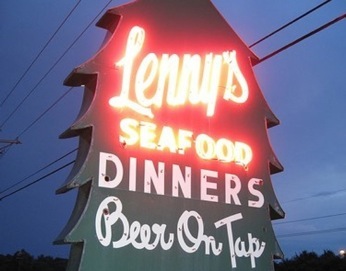 Dan Rebarchick, owner with his wife, Robyn, of Lenny’s in California, Maryland, a landmark for the last 60 years, is skeptical of the National Restaurant Association’s optimistic forecast. There is some cause for concern: although restaurant operators reported positive same-store sales for the 16th consecutive month in September, results were much softer than recent months, the Association has said.
Mr. Rebarchick says his business is off 15 to 20 percent. He’s responded by adding specials that include different food choices and more price points, with an eye to keeping the menu balanced in terms of variety and cost.
One obvious change has been in lunch traffic, he says. “When the price of gas goes up, we see fewer people at lunch, because that’s a discretionary item. They become brown baggers instead.”
The competitive landscape has changed, too. “In the last five years we’ve had an infiltration of corporate, fast-food type restaurants which are taking a piece of the pie now we didn’t have to compete with before,” Mr. Rebarchick says. “Five years ago, business was good. For the last three or four years, particularly the last two and three, business has steadily decreased for my business and other independent restaurants.”
Independent restaurant owners like the Jaffreses and the Rebarchicks have the advantage of being able to adapt quickly to the local business climate and customer preferences, given that the relationship with diners is up close and personal. In contrast, chain restaurants work off a corporate, one-size-fits all template. The advantage for them is widely tested menus and marketing strategies that can be put to work in hundreds of locations.
Olive Garden, for example, is a chain of 730 restaurants and 86,000 employees, whose brand has become widely known since its 1982 founding. But operators of casual-dining restaurants like Olive Garden are struggling to increase sales as patrons look for more value in their dining options, the Associated Press reports, with Chipotle and Panera Bread among the chains benefiting from more bottom-line oriented diners. Olive Garden rolled out a new ad campaign in October highlighting lighter, lower-calorie options. It’s also adjusting its marketing and menus to appeal to those with hectic and varied schedules, moving away from its image as a place where la famiglia sits down together for a leisurely meal.