MD Restores Five Oyster Sanctuaries

Dots of spat, or juvenile oysters, are visible on an oyster shell taken from a holding tank at Horn Point Hatchery. Taken to restoration sanctuaries, these spat become the next generation of oysters. (Maryland DNR photo by Joe Zimmermann)
Maryland has met its commitment to restore five oyster tributaries in the Chesapeake Bay by completing oyster restoration in the Manokin River Sanctuary on the Lower Eastern Shore.
The oyster restoration projects—among the largest in the world—have been highly successful at helping bring back oyster populations, building habitat and supporting economic growth in the Chesapeake Bay. Gov. Wes Moore made the announcement earlier this month.
“This restoration supports our commitment to bringing the oyster population back in five rivers by 2025 and the larger effort to support the repopulation of oysters in the Chesapeake Bay, which has more than tripled in the past 20 years,” Gov. Moore (D) said. “Our success represents the best of government collaboration to systematically address a complex environmental issue with real economic impact.”
Oysters are a key driver of Maryland’s commercial fishing industry. Average dockside value saw a more than 300% increase from before restoration began, with watermen bringing an average of 475,000 bushels of oysters annually for an average dockside value of more than $18 million annually during the previous five years.
Prior to restoration beginning, Maryland watermen harvested an average of 116,000 bushels per year for an estimated dockside value of $3.5 million annually from 2005 to 2010.
A keystone species in the Bay, oysters are ecologically important for filtering water and providing habitat for fish and other aquatic life. The oyster restoration sanctuaries are permanently closed to harvest, except on aquaculture lease sites, and are intended as areas where oysters can grow undisturbed for their many ecological benefits. With restoration sanctuaries, scientists also hope to increase the Bay’s overall spawning stock of oysters and facilitate natural disease resistance.
Maryland Department of Natural Resources Secretary Josh Kurtz joined federal, university, and nonprofit partners for one of the final oyster deployments in the Manokin on Sept. 2, adding thousands of new oysters to mark the completion of more than a decade of successful oyster restoration efforts in Maryland.
The moment in the Manokin marked the culmination of 14 years of large-scale oyster restoration in Maryland and ensured the state would meet its Chesapeake Bay Watershed Agreement commitment of restoring native oyster habitat in five tributaries by 2025.
Virginia restored five tributaries in its portion of the Bay as well.
Maryland’s other completed oyster restoration sanctuaries are the Little Choptank River in Dorchester County, the St. Mary’s River in St. Mary’s County, and Harris Creek and the Tred Avon River in Talbot County.
In restoration sanctuaries, scientists are finding several promising signs of long-term oyster recovery, such as the establishment of dense three-dimensional oyster reef structure, multiple age classes of oysters, increased oyster biomass, and natural reproduction. The 2025 stock assessment, which found oysters in the Maryland waters of the Bay had increased from 2.4 to 7.6 billion in 20 years, also found that the population of oysters in the area of the first three restored sanctuaries grew by a combined total of about 700 million oysters.
Learn more about the restoration here.
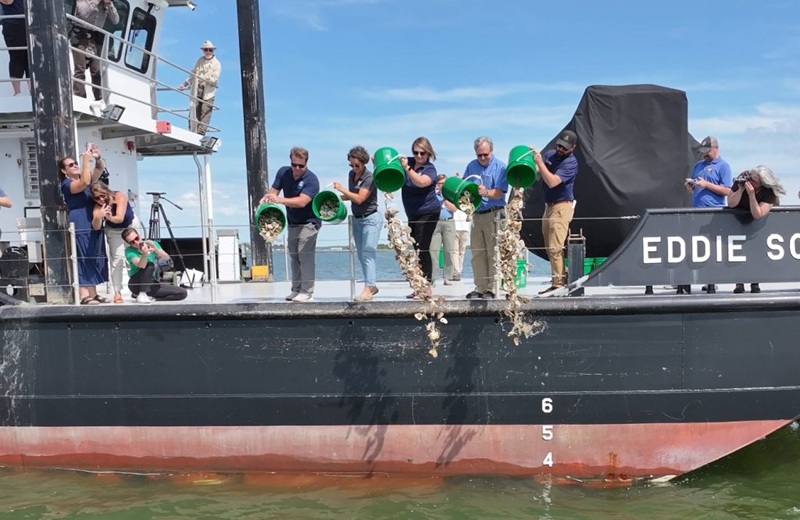
Maryland Department of Natural Resources Secretary Josh Kurtz, left, adds dozens of spat-on-shell oysters to the mark the completion of the Manokin River oyster restoration sanctuary together with Mike Sieracki, director of the University of Maryland Center for Environmental Science’s Horn Point Laboratory; Allison Colden, Chesapeake Bay Foundation Maryland executive director; Angela Sowers, integrated water resource management specialist at US Army Corps of Engineers, Baltimore District; and Ward Slacum, executive director of the Oyster Recovery Partnership. (Maryland DNR photo by Winn Brewer)