NAWCAD Prepares College Students for Careers at Pax River
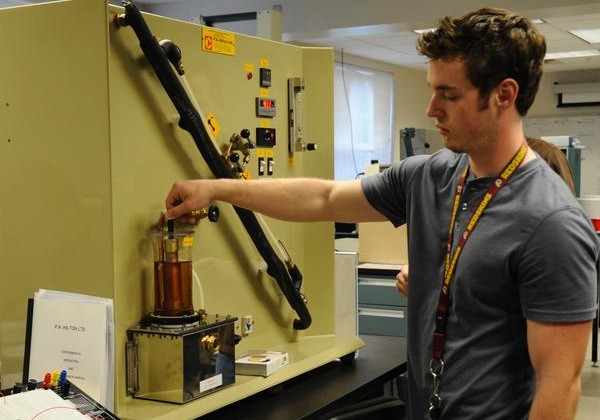

Craig Branson demonstrates heat exchange between fluids in a Transfer Processes Lab at Southern Maryland Higher Education Center. Branson is part of the Cooperative Experience Employment Education Program that provides on-the-job training for students wishing to work at Naval Air Station Patuxent River. (U.S. Navy photo)
Growing up in Leonardtown, Md., Christopher McDaniel set his sights on working on aircraft at nearby Naval Air Station Patuxent River.
Now, a program offered to mechanical engineering undergrads at Naval Air Station Patuxent River has brought McDaniel’s dream to reality. The Southern Maryland – Mechanical Engineering (SMD-ME) program is part of the Cooperative Experience Employment Education Program (Co-Op) that provides on-the-job training for students wishing to work at the nearby naval base.
The Naval Air Warfare Center Aircraft Division’s (NAWCAD’s) SMD-ME allows mechanical engineering students to acquire work-related skills for jobs throughout the command, in addition to academic learning in the classroom. Started in 2009 under Dr. Paul Hoffman, the program is now coordinated by Dr. David John Barrett, director of Engineering Education and Research Partnerships.
“The students learn scientific and mathematical methodologies that are readily applied in their professional life,” Barrett said. “At Pax, these methodologies are used in engineering design and decision making, system evaluation and fleet management.”
Co-Op students and graduates work in various NAWCAD departments, including Human Factors; Integrated Battle Space Simulation and Test; Systems; Avionics; Air-Vehicle; Flight Test; Research and Intelligence; Power and Propulsion; Integrated Systems Evaluation; and Warfare Analysis.
Co-Op graduate John Farnese works in the Helmet Lab at NAS Patuxent River as a mechanical engineer for Personal Protections Human Systems. Some of his duties include impact testing; River Snag testing for helmets; performing demonstrations in the lab; and writing test and mishap reports.
“My favorite aspect is the testing,” Farnese said. “I like hands-on work in the lab. Seeing new technology is pretty cool. I get to see it before everyone else.”
Co-Op professors at the Southern Maryland Higher Education Center (SMHEC) are current and former Naval Air Systems Command employees (NAVAIR). Farnese said they provided him with valuable insight for his career on base.
“I already knew how to write test reports,” he said. “It gave me an advantage over other workers. What you do in the classroom is geared towards what you do on base. The base is a lot more structured, so it made sure that what you did could be applied to your work.”
Learning the importance of networking from his professors proved useful for McDaniel in his job at NAVAIR.
“Networking makes it easier to get the answers to questions faster and learn more about what goes on, allowing us to get more work done,” he said. “When dealing with fleet support work, a good portion of the job is knowing who to ask to get questions answered to avoid running down the rabbit hole and having to go through multiple people, each referring you to someone else.”
The program’s modest class size was also an asset, McDaniel and Farnese said.
“The small class size was definitely a benefit to the program,” McDaniel said. “It made the classroom environment more productive. In small classes, it is easier to ask questions and have one-on-one time with the teacher because there are not as many students.”
It also saved time.
“You don’t have to wait in line to use the equipment with five students,” Farnese said. “You can be hands-on with it. You’re not just watching the instructor use the equipment.”
To successfully complete the SMD-ME, students must earn an Associate of Science degree, their associate degree in engineering at the College of Southern Maryland or complete the equivalent at any other school. For their junior year, students need to be admitted to the University of Maryland (UMD). Students work on base during the summer months and winter breaks, and execute the academic part of the program during the school year. Classes primarily take place at SMHEC, but each semester at least one class is held at UMD.
Students have the opportunity to take courses in fluid mechanics, transfer processes, electronics, measurements, controls, fatigue, vibrations and aerodynamics.
Other perks of the Co-Op include paid tuition up to $4,500 per semester; summer and holiday work at NAWCAD; and a high probability of obtaining professional employment after graduation.
Co-Op student Stephen Bell said he got what he bargained for.
“This program has met my expectations as far as delivering on what was advertised,” he said. “I am graduating from the University of Maryland with a job at Pax and at no cost to me. Not many graduates can say they have a job and went to school with little or no expenses.”
Although the Co-Op program is in the pilot stage, it is quickly expanding. The first class consisted of five students and this fall’s incoming class could include as many as 17.
The program could expand.
“If the pilot program [for mechanical engineering] is successful, then the plan is to develop an electrical engineering program,” Barrett said.
For more information about NAWCAD’s Co-Op program, contact Dr. David John Barrett at 301-342-9360 or [email protected].
Source: NAWCAD Public Affairs