NAVAIR Panel Opens Sea-Air-Space 2026 Expo
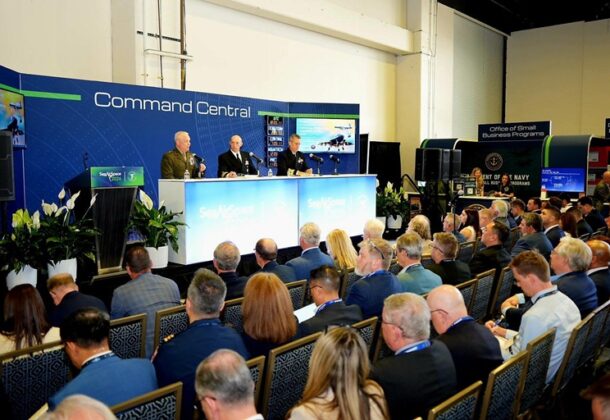
BRIG GEN David C. Walsh, program executive officer for Air Anti-Submarine Warfare, Assault & Special Mission Programs, left; RADM Joseph B. Hornbuckle, program executive officer for Tactical Aircraft Programs; and RADM Anthony E. Rossi, program executive officer for Unmanned Aviation and Strike Weapons speak at the “Program Leadership Perspective: Delivering Warfighting Capabilities to the Fleet” panel at Sea-Air-Space Exposition 2026 hosted by the Navy League. (US Navy photo)
A panel of experts spoke April 20 about current US Navy acquisition challenges, readiness, future force development, operational strength, speed to the fleet, and workforce excellence at the NAVAIR booth on opening day of the Sea-Air-Space Exposition 2026 at the Gaylord National Resort and Convention Center, hosted by the Navy League.
The panel, “Program Leadership Perspective: Delivering Warfighting Capabilities to the Fleet,” was hosted by BRIG GEN David C. Walsh, program executive officer for Air Anti-Submarine Warfare, Assault & Special Mission Programs; RADM Joseph B. Hornbuckle, program executive officer for Tactical Aircraft Programs; and RADM Anthony E. Rossi, program executive officer for Unmanned Aviation and Strike Weapons.
BRIG GEN Walsh began by talking about how readiness and capability of warfighters and systems is currently going through organizational changes to speed up delivery.
“[By reorganizing, we’re] trying to flatten the organization speed to decisions, reducing bureaucracy,” he said. “I think even more important than that is the culture change that we need to undertake in the warfighting acquisition system. It’s not just on the government side; it’s also on the industry side as well and the fleet—a culture change that is more focused on outcomes than compliance and more focused on speed than getting the perfect answer the first time out.”
RADM Hornbuckle said the themes of readiness, capability and speed to fleet are currently being reflected by how sailors and Marines are performing in the theater of combat today, referring to current challenges abroad.
“The talented young sailor and Marines out there at the tip of the spear fighting through adversity, are really delivering some amazing effects downrange,” he said. “What the entire team has done is generate readiness, even in that environment, despite contested logistics … we’ve been able to [work] closely with our industry partners with a rapid evolving threat base to deliver … different warfighting capabilities in a matter of a few days.”
RADM Rossi said unmanned weapons is the next generation of naval aviation, highlighting efforts to get the MQ-25 Stingray refueling drone mission capable and out to the fleet, as well as citing the current MQ-4C Triton currently deployed and fielded.
“As the enemy changes things on the battlefield, the MQ-4 is being sustained and operating, and it is doing a great job,” RADM Rossi said.
In response to questions regarding an MQ-4 Triton being lost during recent operations and the reports of less expensive munitions being hit with more expensive munitions, Rossi said the Navy is always looking at ways to change the capabilities they are using to address the threats in real time, adding new capabilities to existing weapons and platforms at a lower price point.
“We want to not only bring weapons faster, but to bring weapons that can integrate faster,” RADM Hornbuckle said. “The move that we have toward modular open systems architecture is very deliberate. We want to integrate much faster than we have been able to in the past. We’re dealing with very adaptive adversaries, and we want to adapt faster.”
In discussing contested environments and the challenges presented to them, BRIG GEN Walsh and RADM Hornbuckle both said current conflicts have shown that maintenance at every level is important and that deploying more materials for repairs in the field than originally projected is key in making sure critical components continue to function.
“All of our program offices are conducting reliability control boards,” BRIG GEN Hornbuckle said. “There is a venue that looks specifically at our top degraders. It is both government and industry, so if you are a stakeholder or a supplier and you’re not engaged in those forums, please get engaged.”
Pointing out the ecosystem surrounding NAVAIR headquarters, seated at Naval Air Station Patuxent River, each of the panelists responded to a question as to how NAS Pax River is taking advantage and giving back to the county it resides.
“We cherish our workforce, in and around the NAVAIR campus and St. Mary’s County, as we do with all of our partners around the country and around the world,” RADM Hornbuckle said. “There’s tremendous opportunity. All the things that we have talked about with acquisition, transformation, speed, and scale. What we’re looking for there is our partners, either government or industry, in the local area to adapt to that same mindset. And I think, to be quite honest, the opportunities are near endless.”
Looking ahead, the panel was asked what they needed from industry partners to continue delivering combat power today while preparing for a more contested and technologically advanced future fight.
“What we’d like to see is you be aggressive partners and bring us your ideas,” RADM Hornbuckle said. “What would need to change to field [a capability] in half the time?”
“I’d say the biggest complaint we get is that we are that we deliver late and a lot of times that’s [because] we underestimate the amount of technology that’s required or the status of what we’re getting ready to deliver,” RADM Rossi said. “[We should work] together to make sure we really understand the technology we’re going after, what capability we need, and then getting a quality proposal in and then executing it.”
“I think it is working differently with us and thinking differently with us,” BRIG GEN Walsh said. “I think on the government side, we’ve become compliance-focused, risk-averse and we need to think differently on both sides of the equation. I ask you to think with us and work with us through that and be willing to take a little bit of risk to generate outcomes.”
Sea-Air-Space is the Navy League of the United States’ Global Maritime Expo, bringing together defense industry leaders, military decision-makers, government officials and academic experts to share the latest advancements in maritime and naval operations, including threats and operations across underwater, surface, air and space domains.
The event emphasizes integrated approaches to maritime security and defense, reflecting the interconnected nature of modern warfighting environments.
For more information, go to the expo’s website.
This article was provided by NAVAIR News.