FAA Halts Domestic UAV Testing Site Selection
 Morning Coffee is a robust blend of links to news around the Internet concerning the Naval Air Station Patuxent River economic community. The opinions expressed here do not necessarily reflect those of the Leader’s owners or staff.
The FAA has indefinitely delayed selection of national sites for unmanned aircraft trial flights in domestic civil airspace, stalling a Congressional push and delaying the chance that Southern Maryland will be selected, according to FlightGlobal.
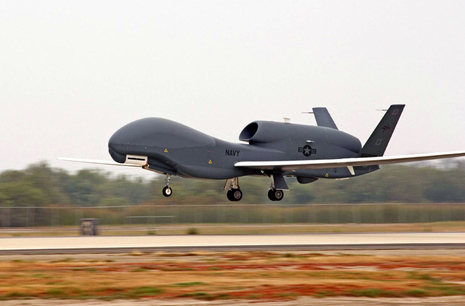
RQ-4A Global Hawk Broad Area Maritime Surveillance Demonstrator
Rear. Adm. Randy Mahr signs off as he leaves NAWCAD to work on the Joint Strike Fighter program.
Politico says the defense industry is cautiously optimistic about sequestration getting fixed. Honeywell begs to differ (PDF). The Hill says that the defense industry has been locked out of the debate. Forbes thinks that sequestration will get blunted by incremental changes. The Wall Street Journal sees investment slowing down (video) as a result of sequestration and the global slowdown. Aviation Week predicts a showdown between the military services over the budget. Time says the Pentagon still has no idea where all of its money is going. Federal workers plead for clemency in any debt deal, according to Government Executive.
Inside Defense (paywall) has a few Navy UAV updates: The Defense Acquisition Board will meet to decide whether to approve new actions in the MQ-4C Triton BAMS program, the Fire Scout program is facing a 19-month delay; and a draft RFP for the UCLASS program is coming “soon.”
The second production model of the F-35B stops by Pax River. Meanwhile, the Marine Corps creates a workaround for a vulnerability in the plane’s mission system, FlightGlobal reports.
Lt. David Berlin receives a surprise hero’s welcome at St. John’s School, according to the Enterprise.
Simmonds Precision Products Inc. gets $6.8 million more from NAVAIR for 28 integrated mechanical diagnostic and health usage monitoring system kits in support of the AH-1Z and UH-1Y aircraft.
Aviation Week says defense contractors make juicy targets for foreign hackers.
Human Rights Watch and Harvard Law School’s International Human Rights Clinic warn against autonomous strike capability, calling such platforms “killer robots.”
The Chinese military is turning up its nose at the country’s latest domestic stealth jet, Aviation Week reports. Meanwhile, a Chinese shipbuilder is urging the government to build its own aircraft carriers.