A $500 Permit Nets Piney Point an Oil Refinery
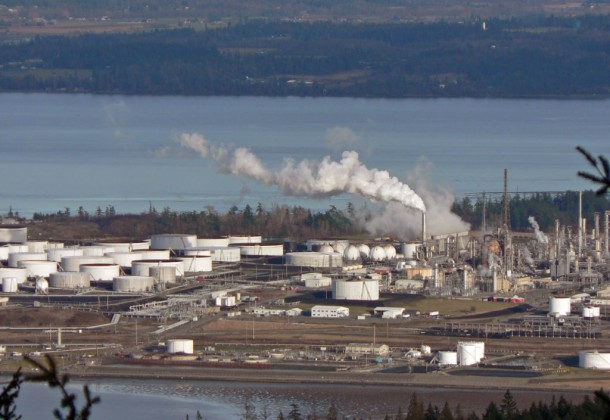
Shell Oil Company’s Puget Sound Refinery, Anacortes Refinery.
The SlackWater Center at St. Mary’s College is a consortium of students, faculty, and community members documenting and interpreting the region’s changing landscapes. Oral histories are at the core of the Center, which encourages students to explore the region through historical documents, images, literature, and scientific and environmental evidence. Some of this work is published in the print journal SlackWater, some of which is online and some published here.

Bayonne On The Potomac, Part I: St. Mary’s County vs. Steuart Petroleum
by Kirk Davis and Julia King
You probably know this, but they actually got a building permit to build an oil refinery. Walked into the planning office and told the poor little clerk in there, “we want a building permit for a refinery.” It was like a 500 dollar fee, and she wrote it and gave it to them. There was nothing legal to prevent it.
That kind of woke people up. If you could go down to Piney Point and build a refinery, maybe we do need some controls on what’s going on and where you can put stuff.
—Robin Guyther
It was sometime mid-June 1968 when the public learned of Steuart Petroleum’s plans to create a Foreign Trade Zone and construct a $40 million topping plant in Piney Point, Maryland, a facility capable of refining crude oil into heating oil. Steuart Petroleum, which already owned an oil offloading facility at Piney Point, envisioned an extremely profitable operation that would be the second of its kind on the East Coast. In May, the county commissioners had met privately with Steuart and supported the company’s plans. Shortly thereafter, permits to build “four structures” at Piney Point had been issued. In June, the public got wind of those same plans.
And so began what The Enterprise called one of the most bitterly fought controversies St. Mary’s County has ever seen, with Steuart Petroleum and its supporters in one corner and, in the other, an initially unorganized and motley assortment of everyday citizens.
Now, it would be easy to cast this struggle as one of good [citizens] versus evil [refinery], but that would be a mistake. After all, this was the period when slot machines had just been phased out and the state—which supported the refinery—was working hard to bring economic development to Southern Maryland. Indeed, just across the Patuxent River, in Calvert County, a nuclear power plant was in development. Two coal-fired electric power plants were under construction in Charles County, including Morgantown on the Potomac and Chalk Point on the Patuxent. In that context, plans to build a refinery were really not so out-of-place.
And, Steuart Petroleum and the Piney Point community had managed to co-exist for quite awhile. Catching and processing seafood was the largest industry in St. Mary’s County at the time, accounting for approximately 1,500 jobs, and commercial watermen were heavily dependent on the Potomac River. Despite the occasional small-scale oil spills that accompanied Steuart Petroleum’s standard operations, the company and the community generally got along. Many watermen worked at Steuart to supplement their income.
Maybe it was the secrecy. An editorial published in The Washington Post declared that “it is nothing short of scandalous that the county commissioners conditionally approved the project without conducting public hearings or giving local residents notice of what was afoot.”
Or perhaps it was the much higher potential for oil spills and environmental damage. Only five years earlier, Rachel Carson’s The Silent Spring had shocked Americans with its revelations about the impact of chemicals on the natural environment.
Whatever the reason, citizens mobilized quickly. The Potomac River Association (PRA) was established for the sole purpose of protecting the river. Its first mission: stop the oil refinery.
PRA spread news of Steuart’s plans and helped organize a public meeting held on June 22, 1968. More than 200 people showed up to voice their concerns over the potentially detrimental environmental effects that the proposed topping plant would have on the community. There was no doubt: residents were opposed to the refinery. PRA immediately began a letter-writing campaign, addressing their concerns to everyone from President Lyndon Johnson, to national and state legislators, to local elected officials.
The effort paid off. A few weeks later, in July, Delegates Henry Fowler and John Hanson Briscoe and Senator Paul Bailey appeared before a Waterman’s Association Meeting. Delegate Briscoe defended the county commissioners’ actions, telling the watermen that the commissioners were led by the State Office of Economic Development “to believe it was unwise to disclose any facts at that time; if the information were revealed, competition would enter the picture and the county would lose the industry.” Briscoe believed “the county commissioners had acted honestly, but perhaps too hastily.” For his part, Delegate Fowler declared that, “if Steuart cannot tell us the facts about their plant until we approve it, I am personally willing to risk the loss of the industry [and] will personally oppose them as long as I can.” Senator Bailey was more direct: “If just one of you is going to lose his job because of what is coming here, I’m against it!”
The county commissioners saw the writing on the wall. They suspended the building permits and appointed a nine-person committee to study the proposed operations. Four committee members were drawn from the PRA, including Catherine “Kitty” Barnes. “Everybody knew that the four of us were definitely opposed to the refinery,” Barnes recalled. “The commissioners then selected four that they knew were very much in favor of the refinery … The ninth person who was made chairman was Dr. Patrick Jarboe.” The committee was directed to study all aspects of the project, from the potential for environmental damage to tax revenues and financial background.
In the meantime, the fight over the refinery played out in the community. Steuart Petroleum emphasized the financial benefits the new refinery would bring to the county. The plant, Steuart argued, would “provide employment for at least 100 people with an estimated minimum annual payroll in excess of $1,100,000,” generating hundreds of thousands of dollars in new tax revenue, “which will go far to stabilize and improve the over-all economy of St. Mary’s County.” As for the environment, Steuart promised a modern plant with all the latest technologies, one which “will positively not contaminate the water or pollute the air.” Governmental regulatory agencies would guarantee that “there can be no water or air pollution by any individual or corporation [and] any new plant must comply or exceed the air and water pollution requirements.”
Many people were not convinced. The PRA pointed out that, “when Steuart Petroleum first came to Piney Point, [they] promised about one million dollars a year in county taxes. [They] actually pay about $26,000.”
To opponents, jobs and tax revenue were only a small part of the problem. Instead, it was the potential for environmental damage that galvanized most people. Not only was “an oil refinery the most objectionable type of industry that could move into this or any other area,” declared one opponent, “let there be no question about the ultimate consequences. If one refinery locates at Piney Point, it will be only the first of others that will move in to make the lower Potomac another Bayonne. Oil spills would be one of the most serious types of pollution … Hundreds of watermen and seafood processors would lose their jobs both in Maryland and Virginia. Many would be added to our welfare rolls and our already burdensome taxes would be raised.”
By October, support for the anti-refinery movement was snowballing. Twenty-three organizations opposed Steuart Petroleum’s construction plans and 5,000 county residents—just under 10 percent of the total population—petitioned the county commissioners to reverse their decision. The commissioners, however, were waiting for their nine-person committee to provide them with a recommendation.
In late October, the committee appointed to research the issue came to a decision as they released their 100-page report. Kitty Barnes remembers the tense situation:
It was four to four. After all that study and all the material, neither side had managed to convince the other. There was no animosity, of course, because we all knew each other and we all respected the other people involved. But it was a really forceful debate …
So here it was, tied, and Dr. Jarboe, who was chairman, had to vote.
And I’ll never forget that night, because he just sat there, you know, trying to decide which way to go. It was a terrible responsibility—to have this kind of decision resting on his shoulders—tremendous amount of responsibility.
And no one knew which way he was going to vote. He never in all that time, in all those months of debate, there was no inkling of how he felt. And, of course, we all held our breath, and he voted against the refinery.
And I’ll have to admit, we did a little bit of crowing.
The county commissioners met the following week and, in light of the committee’s recommendation as well as the massive community opposition, rejected Steuart’s plans for a refinery by denying the permit for a Foreign Trade Zone.
But Steuart had permits to construct shop, office, security, and utility buildings, so they devised a new approach. First, in late 1968, the company sued the county in Circuit Court, demanding that conditions be removed from the building permits. Steuart argued that under the current zoning procedures, these permits were all that was necessary to construct the entire topping plant. Next, in April 1969, Steuart requested from the US Department of the Interior permission for importing up to 100,000 barrels a day of residual fuel oil which would be processed in a $60 million refinery and desulphurization plant in Piney Point. Steuart’s new approach would not require state or county approval at all, as long as the company met certain anti-pollution standards.
Citizen outrage—fueled by the tenacious reporting of The Enterprise—forced Steuart to back off and, in late 1969, the company withdrew its application to the Department of the Interior.
Things got pretty quiet after that. Oh, there were still concerns over oil spills at the Piney Point facility, and some controversy over Steuart’s request to extend a pier, but nothing to indicate much action concerning an oil refinery, at least from 1970 through 1972. But still waters run deep. Dr. Jarboe told The Enterprise that the “refinery is not dead” and that people would hear about it again within five years. But, generally, things were quiet in Piney Point.
Dr. Jarboe, however, was right. Five years almost to the day after Steuart Petroleum first sued the county to build a refinery, on November 1, 1973, Steuart announced—again—plans to develop a 100,000-barrels-a-day refinery.
A week later, The Enterprise reported that the county had—again—issued two building permits to Steuart for the purpose of building the refinery.
And, a week after that, the county commissioners tried—again—to rescind the building permits.
This time, the Potomac River Association was ready. And, they had help.
To learn more about The SlackWater Center, visit their Leader Member Page.
SPONSORED BY












Appreciate the read and definitely more to the story
My grandfather Philip H Dorsey sold the property to Mr, Steuart. He was told by Mr, Steuart that he was going to build his personal landing strip there and renovate the manor house for his summer home.
Once grandpa received word about the refinery he organized the original group including Norton Dodge to fight the development of the refinery,
Thank goodness the citizens of St Marys County have always been able to defeat The issues and mandates that are not in the best interest of our dear St. Marys.
Good stuff! A lot of deals were made in the sixties.
One note, Chalk Point Electrical Generating Station is actually located in Prince Georges County.
This is important, appalling and frightening and encouraging too!.
Thanks to the Slackwater Center for posting this.
to Jackie Russel for sharing it.
Vigilance against the dangers of greed can help St. Mary’s County not have to suffer what Calvert
is beginning to experience (and will many-fold more) with Cove Point
The above article about the proposed refinery at Piney Point is quite informative, but omits a significant aspect of the story. The renewed proposal by Steuart in 1973 to build a refinery in Piney Point led to two important events: (1) St. Mary’s County’s State Senator, Paul J. Bailey, introduced a bill in the Maryland General Assembly that would make it illegal for any large industrial businesses to build facilities, such as a refinery, in the County; subject to approval by the County voters in a referendum, and (2) The County Commissioners appointed a second Refinery Study Committee to assess the impacts an oil refinery would have on the County.
The second Refinery Study Committee was initially composed of thirteen members, however, two members resigned shortly before the entire Committee’s review of its final report. The Committee was given a very short time (in advance of the pending referendum) to complete its study. Nevertheless, in the three months of its existence, produced a rather comprehensive report which was transmitted to the County Commissioners on July 5, 1973. Per the original charge to the Committee by the Commissioners, no recommendation was made in the report as to whether the refinery should or should not be built. Rather the Report was a compilation of the economic considerations versus the environmental considerations.
The referendum vote was held on July 23, 1974 and there was a large voter turnout, with the Bailey bill being approved by a 2 to 1 margin —– thus ending any construction of the proposed Steuart refinery.
Thank you for all of the comments. There is a companion piece to this one that does tell the second phase of the story — as Dr. Jarboe noted at the end of the story published here, in 1972, “the refinery was not dead.” The companion piece, is entitled “Bayonne On The Potomac, Part II: In It To Win It” and is available in the print version (Volume 6: The Instant City) for sale at the St. Mary’s College of MD bookstore. This issue contains images of the advertisements produced in support of the refinery. Many of these materials come from the Senator Paul Bailey Archive donated several years ago to SMCM and available to the public (see https://7e0b4e71846676e55dfebfc0686d3ca4d0f59b1e-www.googledrive.com/host/0BziEzulvOw8Ffmt4T3VqRzBGZ2hkeFVCZEl0TDQ1cjNzRS1fdzBURjI1RG83dFU4Mml1cFE/mss018.html).
There is always more to the story and these comments will be incorporated into the SlackWater archive. Thank you to everyone who took time to comment on the story.