2021-1: A Telescope, Anthropomorphism
In March 2020, four Ospreys returned to established nests in Island Creek a couple hundred feet from our house and six Ospreys migrated north for the first time to skirmish over two new nest platforms the Captain had installed off the oyster house next door. A telescope in 2021 led to anthropomorphism, specifically to giving snarky names to the 10 Ospreys. There were so many Ospreys in 2022 the Captain declared St. George Island the Osprey Capital of the World. By 2023 Osprey poop had become a serious island issue. By ’24, it wasn’t an issue anymore.
This is season seven since my Osprey snooping began. My tattling on them continues here.
In 2021, I acquired a telescope sufficient to discern particulars above the lips of the four nests out front. The 10 Osprey I’d erratically watched in 2020 returned and became distinct. So, I named them.
I named them not only with anthropomorphic intent, but ignoble intent, matching an Osprey’s observed behavior to a reductive human stereotype. Speaking for myself, rude nicknames proved a helpful identification nomenclature. 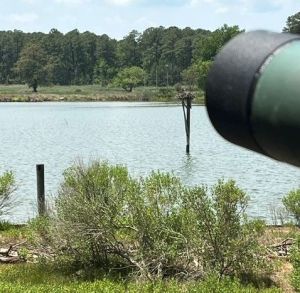
Note: Anthropomorphism is the attribution of human traits, emotions, or intentions to non-human entities. The inverse is the attribution of non-human entities’ traits, emotions, or intentions to humans, like boxers’ nicknames such as Pitbull and Tiger, according to a Stack Exchange Inc. contribution licensed by CC BY-SA. Then another contribution speculated inverse anthropomorphism was merely a mirror effect of our own anthropomorphism.
The telescope confirmed three males and three females returned as the Gang of Six. Skirmishes resumed immediately for a nest site and perhaps also for a mate. But, really, I had no idea. Permanent pairing would seem to have gelled, or seemed near gelling, more or less, then everyone switched around. I second-guessed every identification, a rank amateur at birdwatching, at focusing, at all of this. And yet, unskilled, untrained, and undisciplined, even I saw that these birds were not monogamous.
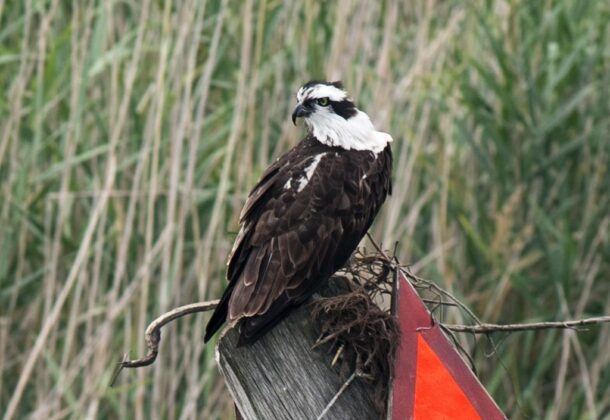
A good-looking banty male was exceptionally popular. He wound up odd-male out when the partnering and nest sorting did gel. He hightailed over to Intracoastal Marker 6, same side of the channel, centered in the two nests’ viewshed.
He perched majestically at the tip of a red triangle of Red-Right-Returning fame. He dropped sticks down its 60-degree slope all season. He retrieved some he saw fall overboard, before they waterlogged. He dropped more sticks than all four of the gang members dropped on their two starter nests combined.
He became Mark-6, as a bit of mockery. Later, learning more about birds’ individualized reproductive controls, I anthropomorphized that Mark-6’s building strategy opted him out of fatherhood, which must be thoroughly exhausting. It left time for Mark-6 to visit females on their nests as well as bring fish to a girlfriend of his own.
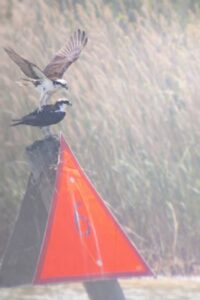
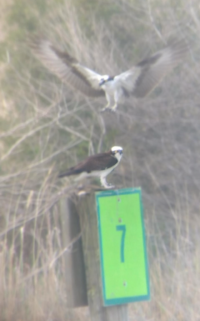 His girlfriend could be spotted on Marker 6, making a go of what could be done at the tip of a triangle. And she also spent time on Marker 7, a square marker and stabler. Who knows where else they mated, but the outcome presented a notorious name for Mark-6’s girlfriend. It really wasn’t female shaming. She simply needed something powerful working on her side.
Read ahead at the link below to the next episode or catch up with the link to the previous episode. To read farther ahead, the seasons’ episodes of 2020-What I Knew Then and What I Know Now-2026 are unfolding at Island Creek Ospreys.
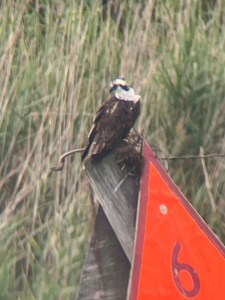
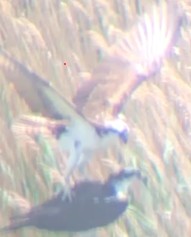
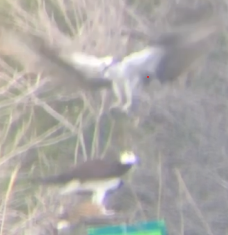
Photos by author taken with an i-Phone clamped to the eyepiece of a telescope; photo at top is an AI Copilot “sharpened” version of this image; birds above “sharpened” by AI, from photos on right.
Next episode: 2021.2: An Exotic Girlfriend
Previous episode: 2020.3: Feeding Osprey